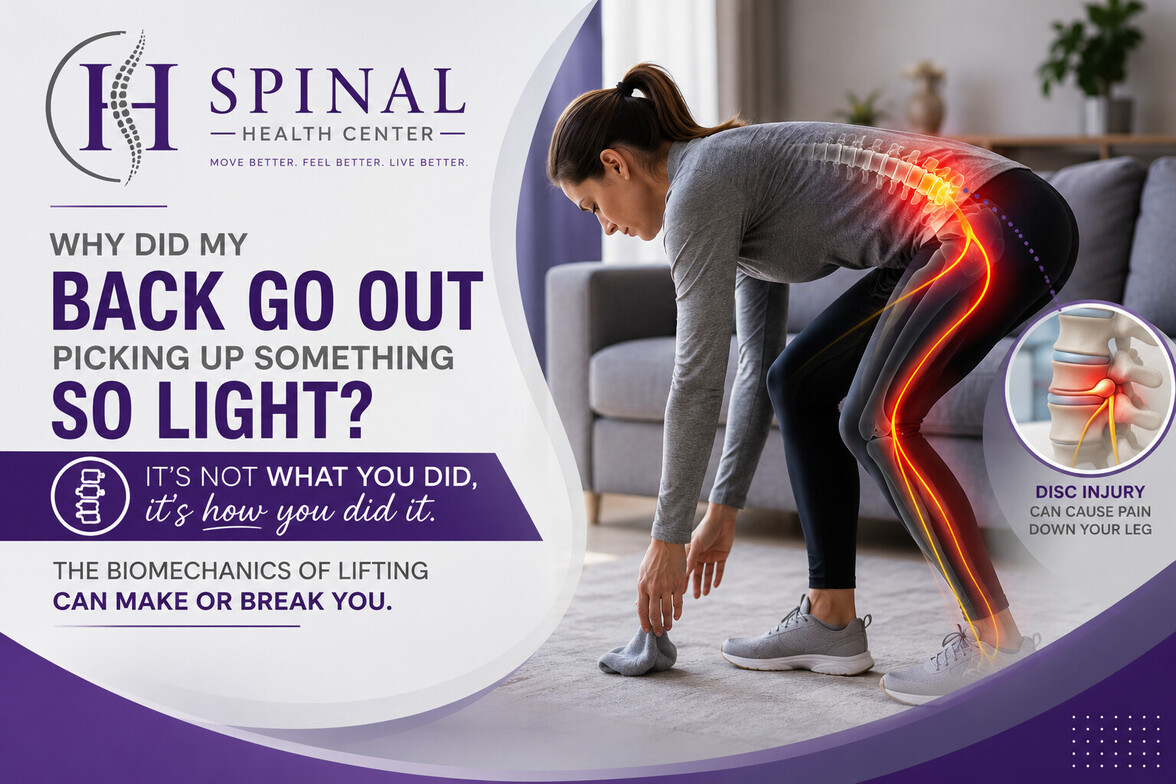
Why Did My Back Go Out Picking Up Something So Light?
Understanding Disc Injuries, Sciatica, and Why It's Not What You Lift; It's How You Lift
"All I did was bend over to pick up a sock."
"I wasn't lifting anything heavy."
"I just leaned over to grab the dog bowl."
If you've ever experienced sudden low back pain that shoots down your leg after doing something simple, you're not alone. In fact, some of the most painful disc injuries we see don't happen while lifting hundreds of pounds; they happen during everyday movements.
The surprising truth is this:
It wasn't necessarily what you lifted. It was how your body was positioned when you lifted it.
Your Spine Was Designed to Move, But It Was Also Designed to Be Stable
Your lower back is made up of vertebrae separated by intervertebral discs. Think of each disc as a strong cushion with a softer center that helps absorb shock and allows movement.
When your spine maintains its natural curves, those discs distribute pressure evenly. But when you bend forward and round your lower back, the pressure shifts dramatically toward the back of the disc.
Now imagine adding:
- Twisting
- Reaching away from your body
- Poor core engagement
- Repeated bending throughout the day
Even if the object weighs only a few pounds, those poor mechanics can place hundreds of pounds of force through the discs in your lower back.
It's the Biomechanics That Matter
Your body is a system of levers.
The farther an object is from your body, the harder your back has to work.
For example, holding a 10-pound object close to your chest is very different from reaching several feet in front of you to pick up the same object. The muscles, ligaments, and discs experience significantly greater stress simply because of the change in leverage.
That's why chiropractors often say:
"It's not what you did. It's how you did it."
One awkward movement may be all it takes when the spine is already under stress.
Why the Pain Travels Down Your Leg
When a disc becomes irritated or begins to bulge, it can inflame or compress one of the nerves leaving your lower spine.
This often causes symptoms such as:
- Pain traveling into the buttock
- Pain shooting down the back or side of the leg
- Numbness or tingling
- Burning sensations
- Weakness in the leg or foot
This pattern is commonly referred to as sciatica, although sciatica is actually a symptom—not the diagnosis itself.
The underlying cause may be a disc injury, spinal joint dysfunction, inflammation, or another condition affecting the sciatic nerve.
Why Did It Happen "Out of Nowhere?"
For many people, the injury didn't begin that morning.
Poor posture, prolonged sitting, repetitive bending, previous injuries, weak stabilizing muscles, and reduced spinal mobility often create stress over weeks, months, or even years.
Then one simple movement becomes the final straw.
The body doesn't always warn you until it reaches its limit.
Proper Lifting Can Make—or Break—Your Back
Good lifting mechanics help your spine do what it was designed to do.
Here are a few simple tips:
- Keep the object close to your body.
- Bend at your hips and knees—not just your waist.
- Maintain a neutral spine whenever possible.
- Tighten your core before lifting.
- Avoid twisting while carrying weight.
- Turn your whole body instead of twisting through your lower back.
These small changes can dramatically reduce stress on your discs.
Chiropractic Care Can Help
Not every episode of back pain is caused by a disc injury, which is why a thorough evaluation is so important.
At Spinal Health Center, we evaluate how your spine moves, how your nervous system is functioning, and how your biomechanics may be contributing to your pain. If a disc injury is suspected, we'll determine whether conservative care is appropriate or whether advanced imaging or referral is necessary.
Treatment may include:
- Gentle chiropractic adjustments when appropriate
- Flexion-distraction or decompression techniques if indicated
- Soft tissue therapy
- Therapeutic exercises to improve stability
- Movement and lifting education
- A personalized recovery plan designed to address the cause; not just the symptoms
Our goal isn't simply to get you out of pain. It's to help reduce the stress that caused the injury in the first place.
Don't Ignore Pain That Travels Down Your Leg
Pain that shoots into your buttock, thigh, calf, or foot is your body's way of telling you something isn't functioning correctly.
The sooner it's evaluated, the better the chance of preventing a small problem from becoming a much larger one.
If you've recently bent over to pick up something light and suddenly developed low back pain or pain traveling down your leg, don't assume it's something you just have to live with.
The movement may have lasted only a second, but the biomechanics behind it have been building for much longer.
Your spine deserves more than temporary relief. It deserves to move the way it was designed to.